Monday, January 27, 2014

IN THE BEGINNING. Genesis 1/1


“In the beginning, God created the heavens and the earth.” Genesis 1:1, ESV

We begin in the beginning, reasonably enough, and someone with the title Elohim (God) taking responsibility for it all. It feels important to point out that Elohim sounds a bit like Sophia Vergara saying “I love him”. I won't often plumb the depths of pop culture like this, so take note.
The Hebrew title Elohim is shared, and perhaps originates from, the ancient Canaanites. Numerous groups in antiquity appear to have used some form of the title Elohim to describe the creator. The root of the title, El, had the well-known connotation of “The strong one” or “The one out in the front.” The writer of Genesis sets out using this familiar title to tell us where we, and all reality, come from.
In the beginning there was The Strength. The Source from which all other things derive their power to live and to be. The River from which all other streams flow.
In Hebrew, adding the suffix im generally makes a word masculine plural. This doesn't work in English, or the name Jim would be the butchest name of all. It may be anyway. Theologians make much or little of the fact that the One God depicted in Genesis 1 is referred to in the plural, depending on their angle. Some sniff at Elohim and confidently declare the scent of the Trinity permeating the first sentence in the Bible. Elohim is one God, yet referred to as containing multiplicity. A corporate oneness. A multitudinous singularity. Others point out that other Hebrew names for individuals, like Ephraim who pops up later in Genesis, are obviously not plural. Unless of course Ephraim was identified by his parents at birth as having multiple personalities. The suffix im is understood in this camp's interpretation as a marker for lofty abstractions, but not necessarily plurals, such as “life” (khayim) or even “the heavens” as is found in Genesis 1:1 (ha shamayim).  
Still others point out that, depending on where you find the term in the Hebrew scriptures, it gets translated God, gods, judges, rulers, powers or even angels. You just have to determine the understanding from the context. And of course, from what ideas you bring to the text beforehand. 
Where do I come out on it? Not certain. I used to be certain because I used to know everything with certainty. The more I learn, the less certainty about these sorts of things holds for me any appeal. But I am struck with the story starting with a seemingly generic term for the Almighty. I'm puzzled by that. Despite knowing others' explanations about God not yet revealing God's name at this point in the narrative, I'm still puzzled. But these days, for me, the more interesting part is in the next verse.


Feel free to share your take, head-scratchings and enlightenment below.

Monday, January 20, 2014

An Absence of Asterisks.

I just walked in and sat down.

I had been speaking with homeless men and women in downtown Raleigh, serving them coffee and letting them know in a simple way, they aren’t forgotten. They’re loved. All that.

Afterward, cold as I was and hoping to check a few things off my work list, I grabbed my laptop out of my car and walked into one of the restaurants flanking Moore Square. They opened at 11. It was 10:38. They’d unlocked their door but no employees were stationed inside. I walked in, greeting no one in particular with a lilt in my voice.

“Hello? Helloooo?”

I walked over to a booth, watching the kitchen door. I knew any moment waitstaff would emerge and I would explain my intentions. When she came out she was already smiling.

“Hey,” I said in a way I hoped was disarming. “I know you’re not open yet. I've been in the Square out front for a couple hours and now, if it’s ok, I was just going to crank out some email. When you’re officially open, I'll grab some food.”

“Oh honey that’s fine. Sit wherever you want. Coffee?”

“No thanks. Maybe some hot tea when you get a chance.”

“No problem.”

I sat down and began replying and forwarding. Earl Grey, ever my helpmate, was soon steeping at my side. 

I looked up at the door and then it hit me.

I couldn’t know it absolutely, but I was confident: There was no way any of the black men I’d just spent the morning with could pull off what I had just pulled off. 

I hadn’t made good on some exclusive invitation. There was no secret handshake. I simply walked in because I know in ways I don’t even know I know that I’m a white man, and hey, everything’s gonna be okay.

It’s often the case that when white men discuss race, they are either talking out of school about how everyone should feel, or expressing what is in some measure white guilt. I am hoping to avoid writing in either of those columns. In the last few years I have really begun to understand a principle at work in this world, of which I am part, that I had been blind to before. And it’s that privilege creates ignorance.

The ignorance I am referring to is similar* to adults forgetting the perspective of a child. Not just forgetting it, but also not realizing they have forgotten it, and therefore fundamentally failing the young human beings they are interacting with. Or the ignorance of someone who grew up in a positive, encouraging, stable home environment saying, “Just suck it up and try harder” to someone wracked with depression and anxiety. They not only don’t know, but they don’t know they don’t know - the surest way to invalidate the humans you think you’re helping. 

I think of it in terms of asterisks in this culture. As a white male in western society, according to how I think of it, I don’t generally have many, if any societal asterisks beside my name. I don’t carry around considerations or mitigators or annotations like others have been forced to. This allows me to walk into a closed establishment and be served, and to assume it would go that way. Perhaps that it even should. When I’ve told black men this story of the unopened restaurant that served me they’ve laughed and shook their incredulous heads. Must be nice. The absence of asterisks gives me an undeniable edge getting a job, even while I assume and claim I was hired for my resumé. It affects what happens, or doesn’t, when I’m pulled over by police. It affects how I’m received by strangers. This doesn’t begin to appreciate the very real economic, familial and educational pitfalls experienced disproportionately by men and women of color in this society seemingly underconcerned about continued gaps between us. The effects of these and other issues I only read about make much of their lives as alien to me as alien life would be. As I’ve listened to people over the years, and paid more attention to my own existence, I see clearly I am not having the same sort of experience as anyone else in the Land of the Free. 

Generalities ahoy. Indulge me a second:

I had a mind-blowing conversation with a woman a while back, and was left feeling like a different species. I could see clearly that if I were a white female, I would have at least one asterisk. Probably more. A clearing of the throat that comes with my entering the room, an alert to others in near undetectable ways that something else besides “human” is being measured, considered, etc. What about attractiveness? I’m a person, but am I an sexually attractive person? If I’m not sexually attractive, in what ways will that cost me? What about intelligence? What about toughness at work? Do I have kids? WHY NOT? As a female, when I walk to my car at night, I wouldn't intimidate. Intimidating others doesn’t even register. If anything, I'd feel intimidated; on guard in ways those with no asterisks couldn’t conceive of. “Woman” means other metrics and considerations are in play that steepen hills men rarely climb and too often claim aren’t there. Statistically, women more fear being taken advantage of or even raped when meeting someone on a blind date. Men fear the girl might be fat.

At risk of sounding like I am setting up some sort of joke, I can’t even imagine being a black lesbian. What is that, three asterisks? Five? After a day in those shoes, would I think America or the church or my job was a good, safe place? Home of the free? Where is “home” when your identity comes, as it does in so many places in our culture, with that many little stars barnacled to it? What would others’ (others with less or even no asterisks annotating them) rules and moralities and claims about freedom and hope and responsibility sound like through those ears? Like giving a well-meaning pat on the back to one with a third degree sunburn, there are pains and insults occurring in ways I couldn’t possibly understand and may unthinkingly find unintuitive and perhaps even wrongly felt. 

How could a white heterosexual male pastor have such confidence so as to tell this dear woman how to live her life, what causes her to be, what she must think and do, so removed as he is from anything like her existence? How would one attach Christ's - Emmanuel's - name to this?

I often hear white men say things like, “Look, I’m not racist. That’s the past and I wasn’t there” or “I treat everyone the same, male, female, black, white, so let’s cut the hypersensitivity crap…” There’s perhaps some substance to some of that. Often political correctness hijacks legitimate attempts at sensitivity and makes everything so taboo, people eventually get frustrated navigating the latest minefield and walk off. But, as a white male that can get hot tea in a closed restaurant, among other plushness I don’t know I’m experiencing on the hour, I’m finding my awareness of ignorance silencing me about how others should be acting or feeling in this world. I have lost the sense that I have the right to say when the conversation should end, or to what degree it has merit. How can those soaring the skies, unaware they are experiencing a rare privilege, have any real understanding, let alone any real empathic guidance, for those who for generations have had clipped wings? Clipped, historically as a matter of interest, by birds who've looked uncomfortably like me. 

And so I have become quiet in my opinions, and more vocal in my advocacy.

Dismissal of all this isn’t an option. Neither is the paralysis of shame and guilt. Both of those widen the divide, so far as I can tell. And most significantly, neither is it an option for me to think the logical outcome of all this is those who are not me are pitiful and weak. 

Much the opposite: there’s nothing as weak as ignorance. 

This flat path I’ve walked has been comparatively steep for others in ways I’m still only beginning to discover at nearly 40 years of age. That path has taken strength I don’t have, and hasn't been required of me. So I'm persuaded the weakness is mine. It’s easy to think my job is to save a world full of victims. My race has perpetuated evil against others and so now my race must be the messiah. 

No one is waiting for me to save them. See them, hear them, yes. But it would only be further ignorance, and arrogance, and weakness, to believe grown men and women are waiting for me to validate their existence and rescue them from my privilege.

So I’m trying to listen. To shut up and really listen. 

I am trying to be more aware of my own assumptions and ignorances, like a blind man who only recently discovered I don't see it never meant it's not there. Voter rights, school funding, enforcement of law, incarceration stats, employment, profiling, targeting, etc, etc. It’s easy to dismiss when you’re not, and never have been, under the heel of much of it. It’s easy to get tired of hearing it like some fad has overstayed its welcome. Instead, I try now to really hear. I don't get political, nor do I wait for the government to do what Christ's body (i.e. an awakened people who can see things as they really are, who speak for those with less voice, not just those who don't sleep in on Sundays) is called to do. I listen, I consider my role, I wake to my ignorance and unintentional complicity.**


I try and really hear and see the frustrating and often times horrific experiences of women in a work place full of men unaware of their own level of unawareness.

I try and remember my answers and ideas come from a place not sharable for millions and millions of my human family. 

I try and remember I don't know what it's like to not have it easier than most all human beings ever. Because I don't. 

Most humbling, I try and remember Jesus gravitated to those who were rejected and marginalized. Rejected by those who could deftly apply Bible verses which made the rejection God’s. I try and remember Jesus called guys like me, who experienced privilege unawarely and insensitive to those in the margins, blind guides. 

I think it would go along way for guys like me to really entertain a hard truth: Privilege makes for blindness, and the trick is this privilege insists we've been seeing all along. But there's a fundamental inability for those in the easy seats to appreciate what it’s actually like to live with all those little stars in tow. There's a spectrum to the human experience, and those blind to their advantage cannot be said to be sharing their lives with the disadvantaged.***

My friend said to me today true compassion is the creativity to imagine the experience of others. He's a black man. One asterisk in this culture? More? That's what I am hoping, to become creative enough to understand life outside my own, and in so doing actually broaden my take on what it means to live a human life, rather than just my comparatively easy sliver of it. To listen closely enough that ignorance and blindness drop like scales from my eyes. With this I will start to understand deeply that my brothers and sisters have had the deck stacked against them. So deeply will I understand this that, as it is with true compassion, I will feel the deck stacked against me. Because until the many become one, it's broken for all of us.


* I want to be careful with my illustration, as it might have the unintended effect of making statements about merit or worth or development. I don’t believe, for instance, that blacks are unmatured people, while whites are mature. The illustration pertains to the ignorance of those "with power".

** Maybe it's me with the asterisks. Maybe I have this backwards. How would I know......

*** I hope you understand this has barely anything to do with money.


Thursday, January 16, 2014

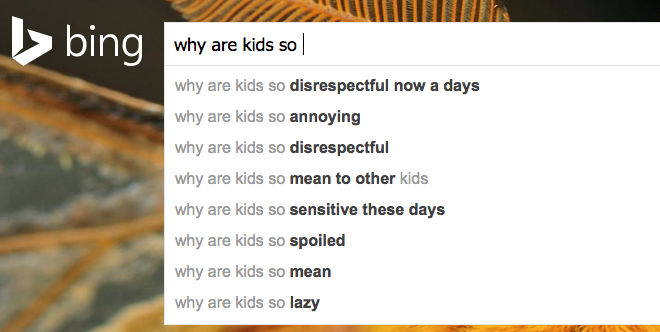
"Why are Christians so. . ."

My friend Wuchen pointed out that if you type the phrase “Why are Christians so…” into the Bing search engine, the suggestions provided are a bit depressing. It looks like some hyper-pessimistic round of $25,000 Pyramid.


I saw the list and shook my head. I hated that the phrase “Why are Christians so loving” or “…generous” wasn’t there. Yet I confess I already knew it wouldn’t be. My foot was caught again in cynicism's mire. Christians....

Cynicism has its merits. It's not always out of place. But it's celebrated as intelligence in and of itself, when really it's a way of describing someone who doesn't want to get hurt by being blinded by naiveté.  Cynicism is often an anxiety. It's refusing to fall for anybody's crap, and therefore assuming crap is what everybody is up to. But in protecting ourselves from getting duped and hurt, we also protect ourselves from recognizing anything beautiful. Our society hails this, a generation with an eyebrow cocked at others while assured all big, powerful, beautiful things are a trap, as "realistic". 

I yanked my foot out of the mire and remembered disenchantment might be en vogue, and that Christians do need some help looking more like Jesus, but there's far more good to the story than bad. I knew the results of a suggested search list wasn't an exhaustive science, but I started Bing-ing again to make good on the rest of my hunch.


So it's not just Christians. It's popular apparently to think of all humans the same way. Christians don't look like Jesus, and therefore are bad. But in the skeptical, wound-wary social conscious, people don't even look like people. They all suck.


Except for a few apparent fetishes, apparently even doctors are in the crosshairs of our negativity. I guess modern thought has no room for them either.


That fifth commandment still taking a beating I see. 

 This one is true.


This has been a good reminder to neither entirely ignore nor listen too closely to the social slogans on what or who's bad. In fact, it's a good sign I'm asleep when I start believing too easily in the most popular disenchantments. Or when I on impulse want to be on the right side of mass judgment so to seem as intelligent as the aggregate social critic demands. Wakefulness means I see with my own eyes. That I shed templates and actually pay attention to the whole story, the bad and the beautiful. And I will do my best to go on being a loving, gracious, potentially naive intellectual with everyone.


Wednesday, November 6, 2013

The Impossibility of Disconnected Sabbath

Kristi left for Atlanta, Sunday. As of Wednesday morning the kids are still alive, but the dog is gone. We had to eat him.

I've hit a routine that works in her absence. Being a morning lark (that is, one of those annoying people who can have meaningful conversations and exercise at 5:00am but can't spell his own name by dinner), I am able to get lunches packed and the crap out of the kids' eyes with time to spare. We've been early to school everyday this week. Much of that is due to Kristi writing out a list of what to pack in their lunches, her going to the grocery before she left to set us up for the week and laying out folded piles of everybody's clothes (not mine, I'm a grown man) ahead of time. This morning as I looked in the fridge and pantry, I thought about the conversation I had on the phone with Kristi last night. She might stay one more day than planned. I fully support it. But I realized I won't have enough lunch stuff to pack for the kids tomorrow. The scales have tipped on laundry too. By this evening, I will have to knock those and other items off the list somewhere between my other responsibilities. Kristi and I share all this stuff for the most part. But when she's gone, I of course have to take up the slack.

Joking aside, it's not a big deal at all. Really. But only because it's a stint. Any inconvenience or pain is bearable when it's known to be finite. This is how people endure highway detours and tattoos and childbirth. The negative part is temporary.

Often I have people express to me their seeming inability for their family to find any rest, to relax. Despite wanting to and clearly seeing the need, it's "unrealistic" or "impossible". Theologically they ask about sabbath. Casually, they say they can't stop. The spirit is willing, but there's only so much week. As I looked into the paltry pantry this morning, I emotionally connected, if only a glimpse, to other people's existence:

There are people who aren't enduring a short stint, waiting for someone of high competence to return and reshoulder much of the load of family living. This is their life.

An isolating pressure cooker of trying to keep the kids not just going through their lists, but engaged as loved sons and daughters. To keep the house clean (or even "clean"), the cupboards filled, meals prepared, bills paid, dog uneaten. And then somewhere in there they have to go to work and meet all their vocational requirements. Somewhere in there they have to leave that job to pick up kids from school. Or schools. Earlier on some days on those hyper-convenient teacher workdays, or when their kids'  young bodies succumb to flu season. And when they or their kids must stay home and be sick, or the car breaks down, or the penalty for late payments disappears automatically from checking, the whole teetering system topples for days. Or longer. Somewhere in all this a social life must limp along, or be postponed till God knows when. Somewhere in there a novel longs to be read. Or written. Maybe after the grass is cut. Leaves raked. Taxes filed. After all that, maybe something fun. Maybe a nap. Maybe after answering that email about being available to volunteer at church Sunday. (Unless kids are still sick.) Over the years, to people who live this life I'm only barely mimicking for a few days, I have preached and counseled You gotta have rhythm. You must rest. Find margin in your days and weeks and claim it. You must know when to stop. And then I've gone home with my wife.

  • Sixty-four percent of children ages 0–17 lived with two married parents in 2012, down from 77 percent in 1980.
  • In 2012, 24 percent of children lived with only their mothers, 4 percent lived with only their fathers, and 4 percent lived with neither of their parents.
  • Seventy-four percent of White, non-Hispanic, 59 percent of Hispanic, and 33 percent of Black children lived with two married parents in 2012.
  • The proportion of Hispanic children living with two married parents decreased from 75 percent in 1980 to 59 percent in 2012. 
SOURCE: U.S. Census Bureau, Current Population Survey, Annual Social and Economic Supplements.


The fourth commandment reads, "Remember the Sabbath day, to keep it holy. Six days you shall labor, and do all your work, but the seventh day is a Sabbath to the LORD your God. On it you shall not do any work, you, or your son, or your daughter, your male servant, or your female servant, or your livestock, or the sojourner who is within your gates. For in six days the LORD made heaven and earth, the sea, and all that is in them, and rested on the seventh day. Therefore the LORD blessed the Sabbath day and made it holy." Exodus 20:8-11

Many centuries later, Jesus said, "The Sabbath was made for man, and not man for the Sabbath." Mark 2:27

Christians over the centuries have tried to understand this ancient command of God (the breaking of which was often an immediately punishable capital crime for ancient Israel, an interesting scenario when one considers the work required to kill a person caught in the act of breaking the Sabbath by picking up and throwing large stones at him) and Jesus' words. I'm asked fairly regularly about the sabbath. "Is it Saturday or Sunday?" "Did Constantine sin by changing it?" "Are we out from under that commandment if we're not Jewish?" These are important questions for which I recommend Google. There's a greater point than the day and letter of the law I'm interested in. 

Note that the commandment mostly deals with others. It starts with me, but then it references to a far greater degree every other person in my life. Even my animals. There are other laws that even command giving your fields a rest, a fair text to reference when you want Biblical support for not mowing the lawn. The fourth commandment isn't really about me as it's about the whole community. When Jesus teaches on the spirit of Sabbath, he speaks of it as not a law demanding to be served and honored, but instead is designed to serve and honor the human beings it was given to. He's always talking about what serves people. To follow him is to serve people. The sabbath, primarily, is a system for others to get the rest they need by my help.

Sabbath is hard. It's hard to stop working, to kick up your feet and say with deep peace, "All that work can wait till tomorrow. I've been a human doing all week. Today, we're human beings." It was hard for the Israelites (thus the command to do it), and it's hard now. But I think it's important for single moms, single dads, and even households with both parents present but all their familial support a city or a state or country away to hear; Sabbath for our culture is nearly impossible. Sabbath was given to people who lived their whole lives together, not folks who prize moving out by age twenty, having their own home and their own career and their own life apart from, ideally, the best support system there is. When the men went out in ancient times, the grandmother, the sisters and aunts were still there to take a turn with a mother's children. Men worked and farmed and hunted, but communally shared their talents and resources so nobody imploded under the weight of isolation. Only an idiot would go it alone apart from the community. I'm told this is the original meaning of "village idiot", one who tried to make it without support. 

I don't mean to romanticize things like ancient gender roles or pre-industrialized family life. I mean to say that the participation in Sabbath was intended for and marked by a community working together, legitimately affording each other their resting, together. Sabbath is only really possible communally. Friends and family living in something the modern eye would recognize (and unfairly judge for the most part) as a commune. As our lives are distanced by degrees from this sort of arrangement, the idea of really resting becomes, by degrees, harder and harder. Living apart from others is living apart from that which allows you to off-shoulder some of your life from time to time.

In Roman times, the wealthiest began living in single family residences called a domus. Your ability to live part from the lower and middle class, on your own, was a sign of power. Plebes, the common folk, lived together in apartments. Often very crudely constructed, the insulae were multi-storey buildings peppered throughout the city and full of people not making it like the minority rich were. These days the thinking is the same- the rich get their precious, private isolation while the poor get packed together like a box of free mutt puppies. But there's another dimension to it now. You don't have to have much money to be rich. Now the wealth of making it on your own trumps the financial aspect. Failure is having to come back home from independence to be interdependent. You can be behind on bills, so long as you have your own car in your own garage. The front room might not have furniture, but we'll pat you on the back and say welcome to the Dream as long as you live your life free of the help of others. Tell a woman you live downtown in a loft you can't afford and that you've filed bankruptcy, and she'll admire you for your tenacity. And you may have some. But tell her you live with your elderly mother and take the bus, and you may be blogged about derisively to her online friends. Never mind we have solid empirical and anecdotal evidence about who it is carrying the most anxiety in our world and who seems to enjoy the easiest peace and joy. The strongest in our society are those the ancients called idiots.

Sabbath is not simple. I have not, and probably never will, fully appreciate the unique exhaustion that comes from being a single parent, or even a married one with no support. I am both married and well connected to others whose backs we mutually have. For all of us who want to step into the spirit of what God is after in sabbath, before we can really enjoy stopping, we must begin something else. We have to be really connected to others for each others' sake, or we are truly poor and without rest. A life no one wants. Sabbath doesn't command I work and rest in proper rhythm as much as it reminds me I'm to stay deeply connected to others so we all can. 

So I'm thinking....

A church with small groups should recognize that having their people get together to study a book every week is good until it begins to ignore the fact that single moms and dads never nap and their kids' homework gets harder to help with every year. 

church with small groups looking for ways to bless locally will recognize the growing number of people, very likely within in their church, stuck in secret cycles of fragile overwhelm. Behold, the objects of your strategized love in your midst!

A church that wants to be relevant will recognize Sunday morning is sacred to many men and women more often for the social aspect than anything else. This is a holy thing. They needn't hear a sermon every Sunday, unless they so desire, to be part of a church. Some are utterly alone with no margin, and sitting silent in a room while one stranger speaks about life to a sea of faces isn't necessarily what their tired, lonely soul needs. 

Churches who want to bless people will put on very, very few events and will incentivize unprogrammed, quiet dinners among its people. The student ministry will look at providing free childcare for events like these as "mission work".*

If disconnected people serve, they should do so in a system that encourages them the other six days like supported family. When they leave, they are too often plunging back into great difficulty. Find ways to follow them without being creepy.**

A person with extra time who wants to live the life of Christ might really consider putting their Bible down more often and seeing if they can create margin for the out-of-towners they live on the same street with. In fact, that person may wish they could start a Bible study on their street, but perhaps the more sacred act would be providing childcare, grocery runs, or just having dinner together. This isn't a Bible study per se, but it is biblical.***

A person who wants to enjoy the life of Christ will wave a flag. They will admit they have perhaps been duped by western, industrialized idiocy and want to move back into support of the insulae. They will realize to lose at society's game is probably a W at reality's. They will embrace something of a feared poverty, in some degree, for a new type of riches. This person will ask for help, guidance and advice, which in my experience results in scenarios like he/she moving back home, moving to a cheaper area, consolidating extra-curriculars, allowing others to help out, the cessation of pretending, and other flavors of humble pie.****

There are a ton more dimensions to this, and my brain is racing a mile a minute on different ramifications to lives and churches. But, I have no more time. Got stuff to do.


* I know many, many people in our church have benefitted from exactly this sort of effort from our students.
** I love how good our church is at this. Volunteers are very connected, checked on, visited, supported, heard and befriended. Key people stay tuned into them, making sure they know how important they are outside of the volunteer work they provide our big church.
*** I like to encourage folks to study the Bible as illiterate people must.
**** This typically happens after some collapse. I suggest it should happen before, but an experienced crisis has always been a more compelling catalyst for change than the anticipation of one.


Sunday, October 27, 2013

Dying to see.

A good friend of mine sent me an archive of last words spoken by executed criminals today. There were hundreds of them in the file, and after about five I began to feel strange for reading them. But I couldn’t stop.
I was struck by the fact each of them felt so similar in tone.
They spoke of God.
They spoke of lasting love and unity for their friends and family.
They spoke of forgiveness.
It’s easy to recognize fear motivating these words seconds before your execution. I’m sure they were scared. But it reminded me I'm a terminal being myself. I have seconds too. Just a lot more of them. Hopefully. As I’ve thought about this I’ve wondered if the relatively short span of our lives, criminals and saints alike, doesn’t serve as a great humbling. An indelible reminder that there’s ultimately nothing to compete for, to divide over or any real reason for which to give in to selfishness. We will die. It’s just a “when?" So we might as well live focused on the goodness of God, enjoying opportunities for unity and closeness with others and forgiving ourselves and others for the ways we thought we could cheat death with selfishness. the things death row inmates speak of in their final minutes.

Perhaps we need death clearly in view to be able to clearly see everything that matters. And maybe this seeing is the beginning of resurrection. That is, the beginning of living forever once death has done its humbling.

May God grant you many, many seconds, and eyes that see forever.

Monday, October 7, 2013

Free way

Last week I bought a new CRV. And since then, so apparently did every third person in Wake County. I now see them everywhere. If I lined up all the CRV's I now see on the roads, I could walk across the top of them all the way to East Liberty Ohio.

Have you noticed this phenomenon? Cars, shoes, coats, haircuts, favorite bands...once you partake, you awaken to the fact that you are part of a mass partaking. Something you didn't notice before becomes all you see.

There is power in confession. Not confession as in going and telling a trained stranger your secrets, but in having a community of people with whom you can share life and be honest. The power isn't that God suddenly loves you again for enduring the pain of humiliating disclosure. The power is in letting your inner world be known and having others not run in fear and judgment like you've be certain would happen since childhood. When we're honest with each other, we not only find there is love available for ourselves, but we also find that the assumed hierarchy of goodness and purity is an illusion. Everyone is struggling. Everyone is broken. Everyone is doing their best to grope through the dark. It's all just a matter of brand and scale.

Confession, or shall we just say, being honest with a trustworthy few, isn't just about revealing the skeletons in your closet. It's reminding ourselves that you're not the only wretch. And once you begin to realize that these things you carry for so long, having assumed you're uniquely terrible or unworthy, are only a slight variation on what everyone else is carrying, you will have peace. You'll no longer judge. You'll no longer condemn. You'll no longer compete because that contest can only be won by lying. You will simply be free to live, free to love every other person because you realize you and every other person were always driving different colors of the same car.


Thursday, September 5, 2013

Tale of two houses.


The first woman saw an old house, deteriorated and neglected, and began to dream of fully restoring it to its intended condition. 

The second woman looked at an old house, curled her nose, and took to sketching out her dream home.

The first sought to understand the original architecture, the period's wood and stone, the history of the property and those who had used the house before.

The second comparison-priced general contractors, then went shopping for paint colors, sofas and interior design magazines. 

The first worked tirelessly, patiently restoring the interior and exterior of the house in perfect accord with its former self.

The second changed and updated every interior and exterior surface, painting and modernizing in perfect accord with her tastes and the latest trends.

The first was thrilled to see the house returning to itself after so many years.

The second was thrilled to see her plans becoming a reality.

The first woman, after a great many months, made the house everything it was meant to be.

The second woman soon made the house everything she'd always wanted.

Both women's hearts were good.

But only the first house felt loved.